Social Robotics Lab

Social robots are entering our society at an increasing speed, providing support in education, healthcare, hospitality, and other domains. This course focuses on designing AI for robots that can communicate socially with humans in an effective and efficient manner, including verbal and non-verbal gestural communication.

Social Robotics

The development of social robots is advancing fast, but their ability to interact with humans –especially with a-typical populations– is still limited in scope, form and effectiveness. For example, automatic speech recognition (ASR) is often flawed, except for most adult speech when processed through the cloud, which slows down interactions and thus effectiveness and acceptability of the communication. Also, non-verbal interaction (e.g., through hand gestures), considered essential for effective communication with humans, is hard to achieve in a meaningful manner. Another challenge is to design the human-robot interaction such that the robot can understand human behaviour and can understand whether the human understands the robot, and that the robot responds in an appropriate manner.

Coordinator

Profile image of Dr. P.A. Vogt

Dr. P.A. Vogt

Assistant Professor, Artificial Intelligence

Research Interests:
  • Human-Robot Interaction
  • Social Robotics
  • Cognitive Systems
Contact:

Email: p.a.vogt@rug.nl

Website: https://www.ai.rug.nl/paulvogt/

Office: BB 410

Lab Information

Robots

AlpahaMini

Alpha Mini

Equipped with 14 high-performance servos, Alpha Mini can achieve a wide range of flexible movements inlcuding walking, dancing and push-up. Rich sensor array and accurate algorithms also help Alpha Mini realize dynamic balance control and obstacle avoidance.

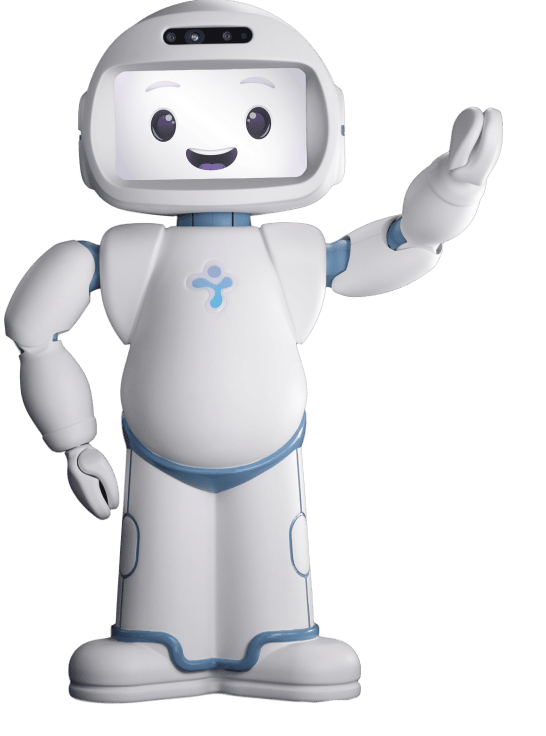
QTRobot

QT robot

QTrobot is an expressive social robot designed to support a variety of use-cases including education of children with autism and other special needs education and human-robot interaction research and teaching.

Opportunities

Bachelor thesis projects

The bachelor projects are designed to engage students in the development and exploration of social robotics within various contexts, including elderly care, interaction enhancements using ChatGPT, co-speech gesturing, and empathetic behavior in robots. These projects aim to improve human-robot interaction through programming and testing with real robots like Alpha Mini and QT, incorporating activities such as literature review, solution design, and evaluation with human participants.

Master thesis projects

The master projects in social robotics focus on developing and researching how social robots can effectively and meaningfully communicate with humans across different groups and application domains, such as education for children and healthcare for the elderly.

Research topics

  • Grounding communication in social robots
  • Child-robot interaction, robot tutors
  • Ethnographic research on language socialisation
  • Computational modelling of language acquisition
  • Gesture use in language acquisition
  • Maternal responsiveness and social media use
  • Experimental semiotics
  • Co-constructions in interaction
  • Word learning experiments
  • Child-computer interaction
  • Social symbol grounding
  • Language evolution
  • Language grounding in robots
  • Concept formation

Courses

Social Robotics Practical

In this practical course students gain knowledge and understanding of the main principles underlying social robotics, and learn to design, implement and experiment with the basics of social robots.

Human-Robot Interaction Social Robots

Social robots are entering our society at an increasing speed, providing support in education, healthcare, hospitality and other domains. To facilitate the development of adequate robots, the field of Human-Robot Interaction (HRI) investigates how social robots best interact with humans in order to enhance the quality of support these robots can give.